
A house fire can affect much more than the room where the flames started. Heat can damage building materials, smoke and soot can move throughout the home, and water used by firefighters or sprinkler systems can spread into flooring, walls, ceilings, insulation, and belongings. Once the immediate emergency is over, homeowners often face a new set of questions about cleanup, insurance, costs, belongings, and the condition of their property.
For homeowners in Ashburn and throughout Loudoun County, understanding what happens after a fire can make the recovery process easier to navigate. Northern Virginia properties range from established homes and townhouses to newer construction, apartments, commercial buildings, and large residential communities. Each building responds differently to heat, smoke, soot, and firefighting water.
Rytech Restoration of Northern Virginia provides 24/7 property damage restoration services throughout Ashburn, Sterling, Leesburg, Dulles, Chantilly, Aldie, Purcellville, Round Hill, Waterford, Great Falls, and surrounding communities. The local IICRC-certified team uses advanced inspection technology and restoration methods to determine what was affected, restore materials that can be saved, and remove materials that are beyond restoration. Rytech also helps property owners navigate documentation and communication with their insurance professionals.
Here are answers to some of the questions homeowners commonly ask after fire and smoke damage.
What Are Common Causes of Fire Damage in Ashburn Homes?
Home fires can begin in kitchens, garages, living spaces, bedrooms, utility areas, and outdoor areas near a structure. Cooking equipment, heating equipment, electrical components, fireplaces, grills, candles, smoking materials, and other heat sources can all contribute to residential fires.
Cooking deserves particular attention in Loudoun County. Loudoun County Fire and Rescue identifies cooking fires as the number one cause of home fires and home fire injuries. The county also provides specific education for heating equipment, fireplaces, propane, electrical safety, smoke alarms, and carbon monoxide protection.
Property layout affects what happens after ignition. Open floor plans can give smoke a broad pathway through a home, while stairways can connect multiple floors. Wall cavities, ceiling spaces, attics, and HVAC systems create additional routes through which smoke residues may travel.
That makes the room where a fire started only one part of the inspection.
“In Ashburn and across Loudoun County, our team works with everything from newer wood-framed homes and townhomes to older properties with different insulation, drywall, flooring, masonry, and HVAC configurations. Those materials and layouts influence how smoke, soot, heat, and firefighting water move through a building. Backed by Rytech’s more than 30 years of restoration experience, we know that a good inspection looks beyond the obvious damage so we can determine what can be restored and what truly needs to be removed.”
Shah Wali, Rytech Restoration of Northern Virginia
What Should I Do Immediately After a House Fire?
Your first priority is getting everyone out and following the instructions of firefighters and other emergency officials. Once outside, remain outside until authorities have addressed the immediate emergency.
After the property has been released, contact your homeowners insurance provider and a qualified restoration company. This starts the recovery process while conditions can still be documented clearly. Photos, videos, affected-content records, and professional inspection findings can help establish what happened and what areas were affected.
Avoid treating soot like ordinary household dust. Moving soot-covered items through unaffected rooms or wiping residues without understanding the surface and residue can spread the contamination. Professional assessment helps establish an organized sequence for inspection, cleaning, drying, contents handling, and material removal.
Rytech Restoration of Northern Virginia provides 24/7 immediate response for property damage emergencies throughout Loudoun County.
How Is Fire Damage Assessed and Inspected?
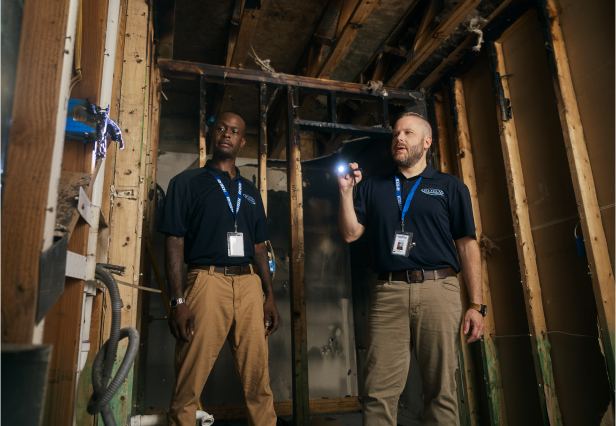
A professional fire damage inspection goes beyond looking for burned materials. Technicians evaluate the areas directly affected by fire along with smoke and soot distribution, odors, contents, building materials, possible HVAC involvement, and moisture introduced during firefighting.
Smoke movement deserves a closer look. Fire restoration guidance recognizes that a building's recirculating HVAC system can provide a pathway for residues to travel away from the source. Assessment findings help determine whether the system warrants additional evaluation.
Firefighting water creates another layer of investigation. The ANSI/IICRC S500 Standard for Professional Water Damage Restoration calls for restorers to identify the extent of water migration using appropriate moisture-detection equipment. That equipment can include moisture sensors, thermo-hygrometers, moisture meters, infrared thermometers, and thermal imaging cameras. Thermal imaging can help identify possible moisture patterns, while findings associated with moisture should be verified with a moisture meter.
Think about a kitchen fire in an Ashburn townhouse. Flames may remain in the kitchen, smoke can travel upstairs, and water may move beneath flooring or into an adjoining room. A surface-level inspection could miss part of that picture.
Professional documentation brings those findings together. Photos, measurements, moisture readings, material conditions, contents records, and project notes give homeowners and insurance professionals a clearer understanding of the loss.
How Do I Start an Insurance Claim After a Fire?

Contact your insurance carrier or agent and report the fire. Have your policy information available and provide the basic details surrounding the loss. An adjuster can then review the claim according to your policy's coverage, deductible, limits, and other provisions.
Create a record of affected belongings as the process moves forward. Photographs, videos, inventories, receipts, and other available records can help document personal property.
Several portions of a homeowners policy may become relevant after a covered fire. Depending on the policy, coverage can apply to the dwelling, belongings, other structures, and additional living expenses. Additional living expense coverage can help with costs above normal household expenses when a covered loss makes a home temporarily unlivable.
For most Ashburn homeowners, a major property claim is unfamiliar territory. Insurance agents, adjusters, carriers, and professional restoration teams work with these situations regularly. Rytech helps by providing photographs, documentation, project information, and direct insurance coordination so everyone involved can understand what the restoration team is finding and doing.
What Is the Difference Between Professional Fire Restoration and DIY Cleanup?
Soot can look like ordinary dirt, but cleaning it requires a different approach. The materials involved in a fire influence the residues produced, and different surfaces respond differently to cleaning.
Painted drywall, unfinished wood, finished cabinetry, metal, stone, flooring, upholstery, and other materials may each require a different method. An aggressive cleaning technique that works on one surface could damage another.
Professional fire restoration begins by evaluating the material, residue, and degree of impact. Technicians can then select cleaning methods appropriate for those conditions. Industry guidance supports a stepwise restoration approach that moves from less aggressive methods toward more aggressive methods as conditions require.
This approach aligns with Rytech's restoration-first philosophy. The goal is to restore affected materials when practical rather than automatically removing everything within the affected area. Materials that cannot be adequately restored can then be identified and removed as part of the mitigation scope.
What Does Fire Damage Restoration Usually Cost?
No single price accurately represents every fire loss. A small cooking fire producing limited soot requires a very different scope than a multi-room fire involving structural materials, contents, water, smoke, and extensive odor.
Current 2026 national consumer-market estimates from Angi place professional fire damage restoration between $3,083 and $52,031, with an average reported cost of approximately $27,477. Soot removal alone is estimated at roughly $2,000 to $6,000. These are broad national consumer estimates rather than Ashburn project quotes.
The amount of affected space matters, but square footage is only part of the equation. Fire type, materials involved, soot conditions, water damage, contents, accessibility, odor, labor, and the amount of material that can be successfully restored all influence the scope.
That last point can make a meaningful difference. When materials can be cleaned, dried, and restored rather than unnecessarily demolished, the project may involve less disruption and fewer costly material removals.
Insurance compensation depends on the individual policy and covered loss. Your insurance professional can explain how your deductible, limits, property coverage, personal property provisions, and other terms apply.
How Are Smoke and Soot Removed?
Professional smoke restoration begins with determining where the residues traveled. The restoration team then evaluates the surfaces and materials within those areas.
Cleaning methods are selected according to the residue and material. Painted surfaces, wood, metal, hard flooring, textiles, furniture, and other contents can require different approaches. The goal is to remove residues while preserving salvageable materials whenever practical.
HVAC involvement may also need consideration. Fire restoration guidance recognizes mechanical air systems as possible pathways for smoke and residues. When preliminary findings indicate an HVAC system may have been affected, further assessment can determine the appropriate next step.
Rytech Restoration of Northern Virginia provides professional fire and smoke damage restoration services for Ashburn and surrounding Northern Virginia communities, combining inspection, cleaning, smoke and odor removal, contents services, water mitigation, and detailed project documentation.
How Are Smoke Odors Removed After a Fire?
Smoke odor often tells a restoration technician something useful. If an area continues to smell smoky after visible surfaces have been cleaned, another affected material or location may still require attention.
Smoke residues can settle on surfaces and enter porous materials, contents, wall and ceiling spaces, and mechanical systems. Effective deodorization therefore starts with identifying and addressing the source rather than simply covering the smell with fragrance.
Depending on the conditions, professionals may use detailed surface cleaning, air filtration, ventilation, contents treatment, and specialized deodorization procedures. The method should match the affected material and fire conditions.
Professional fire restoration guidance incorporates visual and odor assessment into evaluation procedures. This allows technicians to compare the results of restoration work against the established project scope.
What Happens if Firefighting Water Leads to Mold Growth?
Water used to control a fire can soak materials far beyond the burned area. Drywall, wood framing, insulation, flooring, cabinets, and belongings may hold moisture even when their surfaces appear dry.
ANSI/IICRC S500 provides a structured approach to identifying water migration and establishing drying goals. Drying goals are target moisture levels or moisture contents established by a qualified restorer. Those goals are designed to return structures, systems, or contents to an acceptable condition and inhibit microbial growth.
The standard also recognizes that water can move underneath walls and into adjoining rooms even when moisture is not visible on the surface. This is one reason professional moisture meters and other detection equipment are valuable after firefighting operations.
When mold growth develops, the project can require professional mold remediation. ANSI/IICRC S520 covers principles of mold remediation, inspection, structural remediation, HVAC considerations, contents remediation, post-remediation verification, and documentation.
Rytech uses professional containment and mold removal procedures designed to isolate affected work areas, remove affected materials as appropriate, and reduce harmful mold spores in the indoor environment.
What Happens When Fire Affects Structural Materials?
Heat and flames can affect framing, roof assemblies, floors, walls, and other structural building components. The degree of impact depends on the material, fire temperature, duration of exposure, and location within the structure.
Common structural materials include wood, steel, concrete, and masonry. Professional fire restoration guidance calls for restorers to recognize visible evidence of heat and fire impacts that may have compromised structural components and require additional expertise.
This distinction helps explain Rytech's role. The restoration team evaluates affected materials, restores salvageable materials, and removes materials that are beyond restoration. When a structural engineer, electrician, HVAC specialist, or another qualified professional needs to evaluate a specific building system, that expertise can become part of the broader recovery process.
An Ashburn homeowner may see a charred ceiling joist and immediately wonder whether an entire room must come apart. Inspection and professional evaluation provide the information needed to make that decision based on the actual condition rather than appearance alone.
Can Personal Belongings Be Saved After Fire Damage?
Many belongings can potentially be restored. Smoke exposure alone does not automatically make an item a total loss.
Furniture, clothing, décor, household goods, and other contents can be evaluated according to their material, condition, heat exposure, soot, odor, moisture, value, and ability to be cleaned successfully. Some items may be cleaned in place, while others can benefit from professional packout and contents cleaning.
Packout services provide an organized way to inventory, document, remove, clean, and store selected belongings while restoration work progresses inside the property. This can also create more working space for technicians.
When belongings cannot reasonably be restored, detailed documentation becomes valuable for the property owner and insurance professionals. Industry guidance also recognizes that disposal of non-salvageable property may require coordination with materially interested parties when insurance compensation is involved.
What Health and Safety Conditions Can Remain After a Fire?
A fire-damaged building can contain several conditions beyond visible soot. Smoke residues may have moved through the structure, building materials can be affected by heat, electrical components may require evaluation, and firefighting operations can leave materials wet.
Structural conditions can also change. Wood, steel, masonry, and other components respond differently to heat, so areas with possible structural impact may require specialized evaluation.
Smoke movement creates another consideration. Residues may travel through rooms, cavities, and mechanical systems beyond the visibly burned area.
Before thinking about cleaning, ask a more useful question: Do you know the full area affected by the fire, smoke, soot, and water? A professional inspection provides the information needed to answer that question.
How Long Does Fire Damage Restoration Take?
A single timeline does not fit every fire loss. Current consumer-market data estimates that the broader fire restoration process can range from roughly two weeks to 12 months, with an average around four months when reconstruction and other phases are included. A mitigation and restoration company's portion of that timeline can be much shorter depending on the loss.
A limited smoke-cleaning project can move far faster than a fire involving several rooms, contents, firefighting water, structural evaluation, and specialty trades. Drying time, affected square footage, soot conditions, contents processing, odor, access, project approvals, and coordination with insurance professionals can all influence progress.
Commercial losses bring additional considerations. A fire affecting an office, retail property, apartment community, or other commercial building can involve employees, tenants, equipment, inventory, business operations, and multiple decision-makers.
Clear documentation helps keep those parties aligned. Property owners know what technicians are doing, while property managers, agents, adjusters, carriers, and referral partners can follow the restoration scope and progress.
How Do I Choose a Fire Damage Restoration Company in Ashburn?
Begin with qualifications. Look for relevant IICRC certification, proper licensing and insurance, experience handling fire and smoke losses, and an established process for documenting the work.
Next, ask how the company decides which materials require removal. A restoration-focused company should evaluate salvageable materials before recommending demolition. This can help reduce unnecessary disruption and costly material removal.
Communication matters too. You should understand what technicians found, what work is planned, and how progress will be documented. Insurance professionals and property managers benefit from the same transparency.
Rytech Restoration of Northern Virginia serves Loudoun County with an IICRC-certified team, advanced technology, professional inspection methods, 24/7 immediate response, insurance coordination, and detailed project documentation. The Northern Virginia team serves both homes and businesses and emphasizes methods designed to minimize damage while guiding customers through recovery.
How Can Ashburn Homeowners Reduce Future Fire Risk?
Start in the kitchen. Loudoun County Fire and Rescue identifies cooking as the number one cause of home fires and home fire injuries, so staying attentive while cooking can address one of the community's most common household fire risks.
Heating equipment deserves attention during Northern Virginia's colder months as well. Loudoun County recommends turning portable heaters off when leaving a room or going to bed, having heating equipment and chimneys professionally cleaned and inspected each year, and allowing fireplace ashes to cool before placing them in a closed metal container outside and away from the home.
Working smoke alarms add another layer of preparation. Loudoun County recommends alarms in each bedroom, outside sleeping areas, and on every level of the home. The county advises testing alarms monthly and replacing alarms when they reach 10 years of age.
Loudoun County residents can even request a smoke alarm assessment through the county's Fire and Rescue system. The program can test existing alarms, review their locations, assist with batteries, and provide or replace alarms for qualifying homes.
Finally, review your homeowners insurance policy periodically and maintain an updated inventory of your belongings. Photos or video of rooms and major possessions can provide useful documentation if a future property loss occurs.
Get Inspected to Stay Protected After Fire or Smoke Damage
When the fire trucks leave, the most useful question is not simply, “What burned?” Ask instead, “Where did the fire, heat, smoke, soot, odor, and firefighting water travel?”
Rytech Restoration of Northern Virginia helps property owners answer that question throughout Ashburn, Sterling, Leesburg, Dulles, Chantilly, Great Falls, Aldie, Purcellville, Round Hill, Waterford, and surrounding communities across Loudoun, Fairfax, and Clarke counties.
If your home, rental property, commercial building, or insured property has been affected by fire, smoke, soot, odor, or firefighting water, call Rytech Restoration of Northern Virginia at (571) 453-7707. The local team can answer your questions, inspect the affected areas, document the conditions, and help establish the appropriate restoration steps.
GET INSPECTED TO STAY PROTECTED.
FAQs: Answering Your Pressing Fire Damage Repair Questions
At Rytech Northern Virginia, we understand how stressful fire damage can be. That’s why we’ve created a helpful FAQ section to walk you through the entire restoration process. From what to expect during each phase to how we handle cleanup and communication, our answers are designed to provide clarity and confidence—so you feel supported every step of the way as we restore your home or business.


